
White Tape journal · Practical AI
AI needs a harness.
Your business needs the reins.
A useful AI system does more than produce an impressive answer. It works inside clear boundaries, keeps people in control and shows whether the investment is worthwhile.
By Steve Becchio · 27 October 2026 · 7 minute read
You have tried a chatbot. It can write a decent email, summarise a document and occasionally make something up with extraordinary confidence. Meanwhile, every second business post says you are falling behind.
The question is no longer whether AI can do something clever. It is whether it can do useful work in your business, with the right controls and a result worth paying for.
That is where an AI harness comes in.
What is an AI harness, in business language?
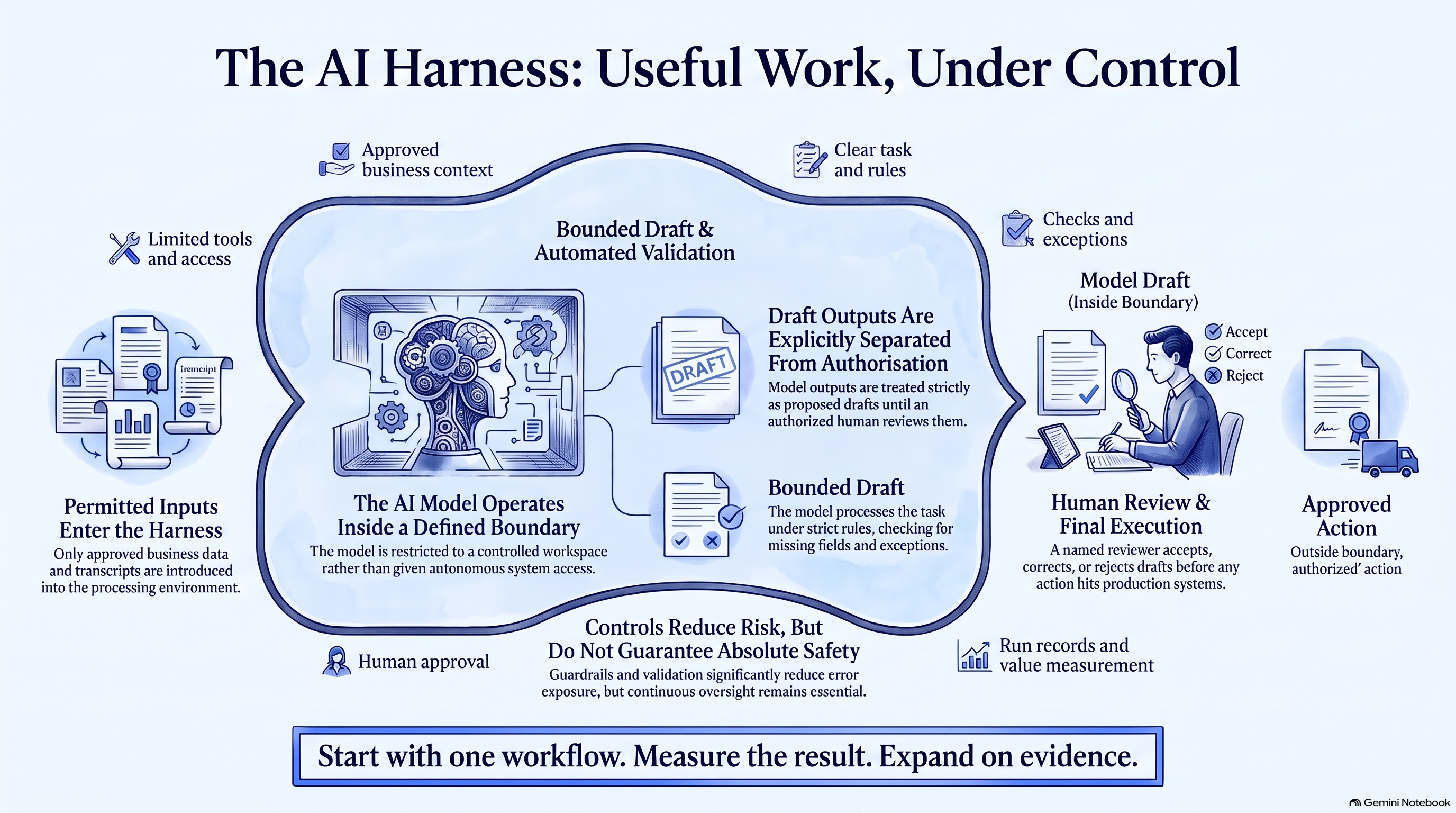
Think of the model as a capable new assistant. The harness is the working system around it: the brief, approved business information, tools it may use, checks it must pass, people who approve its work and records that show what happened.
It is a design approach, not a single product or a safety certification. A folder called “secure” or an instruction saying “be careful” does not enforce a boundary. Access permissions, validation and approval controls must do that work.
An AI-generated “approved” label is not a manager’s approval. The system needs a separate, authorised approval step before a consequential action.
TRY IT FOR YOURSELF
See the harness make its boundaries visible.
Use a fictional invoice to test matching, exceptions, human approval and a draft email. Change the operating settings and see payment and IP-leakage requests blocked.
Open the AI Harness Simulator →Interactive simulator using fixed rules and synthetic data. No live AI, business-system access, payments or email sending.
Six parts that turn a chat into a business workflow
The right information
Approved prices, current procedures and relevant records—with a source and owner. Keep old versions out of current decisions.
A clearly bounded job
Define the input, expected draft, exclusions and what to do when information is missing. “Not sure” should trigger a question.
Only the access needed
Start with specific records and draft destinations. Keep payments, deletion, external sending and system changes outside the AI’s authority unless separately designed and approved.
Evidence before confidence
Validate required fields, totals, duplicate records and source links. Route unclear cases to a visible exception queue.
A real decision-maker
Name the reviewer. Give them the original evidence, time to check it, and the ability to correct, reject or stop the workflow.
A record of the result
Track handling time, review effort, errors, operating costs and approvals. Someone owns the outcome after the builder leaves.
This approach draws on two useful patterns in the research library: Nick Saraev’s separation of instructions, orchestration and execution, and Liam Ottley’s organisation of business context, plans, references and outputs. White Tape’s business adaptation adds explicit ownership, approval boundaries and commercial measurement. It is not an endorsement by either creator.
What it looks like: a service report becomes a quote draft
A technician finishes a job and recommends a repair. The office has to find the customer record, interpret the notes, check the approved parts and prices, and chase missing details before a quote can be reviewed.
Permissioned input
Uses approved references
Missing details are flagged
Approves scope and price
Recorded in your system
The harness can make the handoff clearer without replacing the service platform you already use. If that platform already has the right feature, configuration and training may be the best answer.
Protect your IP by controlling the information flow
Your pricing logic, designs, customer history and operating procedures may be among your most valuable assets. Before connecting them to AI, agree what information is necessary, where it will go, who can access it, how long it is retained and how access can be revoked.
Check the actual service terms and settings for training use, retention, third-party access and deletion. Keep client work separated through access controls, not merely different folder names. Store credentials in an appropriate secret store. Use redacted or synthetic examples while testing, and give the workflow only the information it needs.
Privacy and IP are related but different issues: a confidentiality clause, a privacy setting and ownership rights are not interchangeable. Sensitive or commercially important work may need specialist review. The OAIC’s AI product guidance is a useful starting point for privacy due diligence.
Human oversight has to be more than a checkbox
A review queue is useful only if someone can understand the proposed action. Show the source, the draft, missing information and the changes being requested. An unexplained wall of AI text is a poor approval screen.
Also decide what happens when the reviewer is absent, a connection fails or a document contains hostile instructions. External emails and documents are evidence to inspect, not authority to change the rules. Limit tool permissions and test these failure paths: prompts alone cannot guarantee protection against prompt injection.
Keep a stop control, a named technical owner and a manual fallback. Improve procedures in a test version, then approve material changes before production use.
How does a harness speed up implementation?
It avoids rebuilding the basics for every task. A reusable pattern for intake, validation, review, logging and recovery gives the next workflow a tested starting point. Your team spends less effort rediscovering who owns a decision or why a run failed.
That can shorten the route from idea to a useful pilot. It does not remove the need to understand your process, clean up inputs or test integrations. Reuse the pattern; prove it against your own work.
Anthropic’s engineering guidance supports starting with simpler solutions and adding complexity only when needed. A fixed workflow is often enough; every task does not need an autonomous agent.
Measure the return, not the demo
Start with an observed baseline: task volume, manual handling time, error rate and delay. After the pilot, measure the same work and include checking, correction, maintenance and adoption.
Illustrative planning example · AUD · not client results
Where does the value actually go?
- 200 cases × 12 minutes
- 40 hours/month today
- 40% reduction × 75% effective adoption
- 12 hours potentially released
- Less 3 hours of new review
- 9 net hours of capacity
- At an assumed $60/hour, less $150 operating cost
- $390/month net economic value
- Assumed $2,500 initial investment
- About 6.4 months simple economic payback
Capacity value is not cash saved. The business must use the released time productively. Cash ROI needs actual cash benefits and costs; count extra sales by contribution margin, not total revenue, and avoid counting the same benefit twice.
Useful operating measures include cost per accepted output, correction rate, unresolved exceptions and review time. Useful commercial measures include net capacity, realised margin improvement and payback. Agree a SMART target and a stop decision before the build.
For example: reduce total hands-on preparation time for one document type over a six-week pilot, while meeting an agreed accuracy threshold and keeping every external send behind approval. The target is yours to validate, not a promised White Tape outcome.
Move beyond FOMO. Start with one worthwhile workflow.
Fear of falling behind can lead to rushed purchases. Fear of damage can lead to doing nothing. A bounded, measured pilot offers a practical way forward: learn where AI helps, see where it fails, and keep the authority to decide.
White Tape starts with the bottleneck, checks existing-system options and scopes one improvement. We agree the controls, compare the result with the baseline and hand over the operating instructions. Expand when the evidence supports it; simplify or stop when it does not.
Bring one recurring problem
Let’s find a sensible first step.
Start with the free scorecard or bring your workflow to a free 30-minute virtual coffee with Steve. Afterwards, receive a free call summary and short assessment report with practical next steps. No ongoing obligation.
Steve arranges the call and prepares the report afterwards. Further analysis and implementation are scoped separately.
Sources and further reading
Original White Tape synthesis informed by Nick Saraev’s Agent Architecture and Liam Ottley’s workspace template (course access may be required), with the independently reviewed guides in Steve’s AI Blueprint Library. The infographic was generated in the research NotebookLM notebook and reviewed for this article. Supporting guidance: NIST AI Risk Management Framework, OAIC, OWASP and Anthropic as linked above. These references do not certify a deployment or imply endorsement.